I see them everywhere!
Tuesday, November 27, 2012
Thursday, November 22, 2012
Monday, November 12, 2012
Friends Magazine Revisited
Good things come to those who wait...
On December 5, 2008 and January 9, 2009, I posted images of two pieces of original Edward Gorey artwork in my collection that were published in Friends Magazine. At the time, I mentioned that I was not sure which specific issues of the magazine these images appeared in. Recently, another collector of the works of Mr. Gorey provided me with scans and dates of the magazines in which the art appears.
According to their records, Edward Gorey produced images for twelve different issues of Friends Magazine between 1961 and 1965, but there may be more yet to find. The first of the two pieces of art I have is titled Departing Train(see image above) and was published in the July 1962 issue of the magazine. This remains one of my top five favorite pieces of original art by Mr. Gorey in my collection.
On December 5, 2008 and January 9, 2009, I posted images of two pieces of original Edward Gorey artwork in my collection that were published in Friends Magazine. At the time, I mentioned that I was not sure which specific issues of the magazine these images appeared in. Recently, another collector of the works of Mr. Gorey provided me with scans and dates of the magazines in which the art appears.
According to their records, Edward Gorey produced images for twelve different issues of Friends Magazine between 1961 and 1965, but there may be more yet to find. The first of the two pieces of art I have is titled Departing Train(see image above) and was published in the July 1962 issue of the magazine. This remains one of my top five favorite pieces of original art by Mr. Gorey in my collection.
The second piece of Friends art, Boy With Dog Chasing Butterfly, was published in the January 1963 issue of the magazine. This wonderful image illustrates an amusing article about animals who do not let their human companions tell them what to do. The difference between the humans in the photos and the boy in the drawing is that the boy appears to be enjoying his situation thoroughly!
Saturday, November 3, 2012
Saint Melissa the Mottled
Saint Melissa the Mottled, a new book by Edward Gorey has just come out! Published by Bloomsbury USA, SMtM is available as an illustrated hardcover volume (no dust jacket).
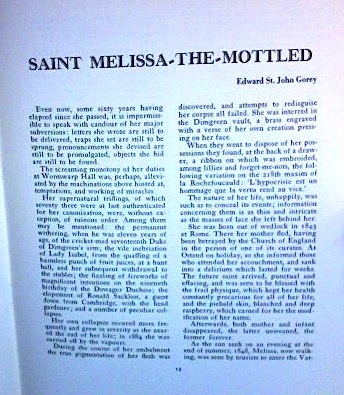
Saint Melissa the Mottled was originally published in 1949 at Radcliffe College in a publication entitled Signature (scans of the original printing were provided by another collector). Radcliffe College, a woman's liberal arts college in Cambridge, MA
founded in 1879, officially became part of Harvard University during
World War II. After serving in the Army during World War II, Edward Gorey attended Harvard University from 1946 - 50.
Mr. Gorey's first published illustrations adorn the cover of the Harvard Advocate in 1950 and he published his first book, The Unstrung Harp, in 1953. It is of interest to note that SMtM may actually be Mr. Gorey's first published story, and may be his only story published as Edward St. John Gorey. This piece of writing predates his first book by three years and gives us an example of his earliest writing. One would need to have access to the Harvard/Radcliffe publication archives to find out if any other published writing by Mr. Gorey predates this story.
Compared to Mr. Gorey's later works, SMtM is text heavy in the same way that The Unstrung Harp is, which is unsurprising since this piece was a short story without illustrations. Both works share a love of language and humor that will become Mr. Gorey's trademark writing style. That SMtM is a less polished text than TUH is evident in the difficult to read final meandering sentence of the book, which awkwardly ties up the loose ends of the story.
The Edward Gorey Charitable Trust, the publishers, and book designer John Candell have done a fantastic job making this volume look like a "Gorey book". Since the story was written by Mr. Gorey but never illustrated, they have chosen "appropriate images from the hand of the author" to accompany the text. The artwork is black and white and comes from a variety of well known and obscure sources. The printing quality of the illustrations varies from piece to piece, some of which are beautifully delicate while others are not reproduced at the same high quality. Like the recently published Edward Gorey's Ghosts, SMtM is a visual pop quiz for the Gorey enthusiast and a must-have volume for every Gorey collector.
Saint Melissa the Mottled was originally published in 1949 at Radcliffe College in a publication entitled Signature (scans of the original printing were provided by another collector). Radcliffe College, a woman's liberal arts college in Cambridge, MA
founded in 1879, officially became part of Harvard University during
World War II. After serving in the Army during World War II, Edward Gorey attended Harvard University from 1946 - 50. Mr. Gorey's first published illustrations adorn the cover of the Harvard Advocate in 1950 and he published his first book, The Unstrung Harp, in 1953. It is of interest to note that SMtM may actually be Mr. Gorey's first published story, and may be his only story published as Edward St. John Gorey. This piece of writing predates his first book by three years and gives us an example of his earliest writing. One would need to have access to the Harvard/Radcliffe publication archives to find out if any other published writing by Mr. Gorey predates this story.
Compared to Mr. Gorey's later works, SMtM is text heavy in the same way that The Unstrung Harp is, which is unsurprising since this piece was a short story without illustrations. Both works share a love of language and humor that will become Mr. Gorey's trademark writing style. That SMtM is a less polished text than TUH is evident in the difficult to read final meandering sentence of the book, which awkwardly ties up the loose ends of the story. The Edward Gorey Charitable Trust, the publishers, and book designer John Candell have done a fantastic job making this volume look like a "Gorey book". Since the story was written by Mr. Gorey but never illustrated, they have chosen "appropriate images from the hand of the author" to accompany the text. The artwork is black and white and comes from a variety of well known and obscure sources. The printing quality of the illustrations varies from piece to piece, some of which are beautifully delicate while others are not reproduced at the same high quality. Like the recently published Edward Gorey's Ghosts, SMtM is a visual pop quiz for the Gorey enthusiast and a must-have volume for every Gorey collector.
Wednesday, October 31, 2012
Happy Halloween!
Saturday, October 27, 2012
Elegant Enigmas in Maine
Elegant Enigmas, the premier exhibition of the work of Edward Gorey continues to travel around the country. The current showing of this fantastic exhibit is at the Portland Public Library in Portland, Maine. On display at the Lewis Gallery through December 29th, the show was brought to Portland through the interest and quick organizational efforts of a few individuals and the Edward Gorey Charitable Trust. Due to the financial support of a local bank, and the generosity and flexibility of the Trust, the show had an extremely short gestation period.
To view a video about how the exhibition came together, click here.
Sunday, October 21, 2012
The Fur Designs of Edward Gorey, Part 2
Here is an interesting article which was sent to me by another collector regarding Edward Gorey's Ben Kahn Fur collection. This article/interview was published in January 1979 when the collection was still in the design stages. It shows several of the drawings Mr. Gorey had completed for proposed fur coats and accessories.
Below, I am typing out the article/interview since the copy can be a little hard to read on the scan and it is an interesting view of/by Edward Gorey:
A FURRY STORY ON EDWARD GOREY
Edward Gorey - successful book illustrator, writer and designer of stage sets for the Broadway production of Dracula - has worked out a business arrangement to design a line of men's furs for Ben Kahn.
On the day of this interview he is going to meet Ernest Graf, President of the firm. Together, they will review Gorey's fanciful sketches and make further plans for the artist's first formal venture into the fashion business.
Edward Gorey walks to his closet silently because he is wearing sneakers as usual with his outfit of the moment or any moment - dungarees and a sweater torn at one elbow. He opens the door.
The closet is stuffed full of fur coats too numerous to count. He has designed them all over a period of many years. There is no room in the closet for his other possessions. His hands, adorned with enormous African-inspired rings of brass and bronze, reach in and pull out the fur of the day - Russian raccoon dyed blue. He slips into it, wrapping it around his sturdy 6'4" frame. The collar swaddles his neck, hiding the gold loop earring in his left ear. Part of his greying beard disappears into the collar as well.
Edward Gorey has six cats, five strays and an Abyssinian. They are his silent critics. Before leaving for the Ben Kahn showroom, he glances at them and at the accumulation of books and illustrations that occupy various spaces in his one-room apartment.
Incredulity and Shock
Edward Gorey's drawings and text, apart from Dracula stage sets and forthcoming pop-up books, have more than a touch of the macabre. But, like Charles Addams, the dark side of his nature works itself out in his art. In conversation, Edward Gorey is a benign and sociable citizen. The most hair-raising statement he made in the course of the pleasant interview was the following:
"Neiman-Marcus is charging $25,000 for a fisher coat. That is one of the lunatic things. I have a fisher coat. It's old-fashioned now because I've had it fifteen years. It's not quite full length but it's very bulky and it has a great big collar and huge cuffs. It's skin-on-skin which is what I prefer anyway. I hate all this letting-out business. I paid (Gorey's voice draws it out slowly and conspiratorially) seven hundred and fifty dollars for it! In fifteen years, a fisher coat has gone up from $750 to $25,000!"
"About fur design," Gorey says, "let the fur speak for itself. I hate fussy designs, these sort of ditsy things, little bits of leather, epaulets, little bits of brass.... My favorite fur is fisher. The most comfortable fur is mink. I have two, three mink coats as a matter of fact...My favorite fur color is bright yellows."
It was suggested that conservationists might consider it decadent to dye fur bright yellow, or blue, or olive green, to which Gorey replied:
"I have my qualms about it. But if you start thinking that way, if you're wearing leather, if you're eating...No. And (he chuckles) nobody's proved that vegetables don't suffer, actually. Maybe every time you pull a carrot out of the ground it's letting out a scream!"
-Lillian Gordon
New York Guide, January 15 - 21, 1979
Below, I am typing out the article/interview since the copy can be a little hard to read on the scan and it is an interesting view of/by Edward Gorey:
A FURRY STORY ON EDWARD GOREY
Edward Gorey - successful book illustrator, writer and designer of stage sets for the Broadway production of Dracula - has worked out a business arrangement to design a line of men's furs for Ben Kahn.
On the day of this interview he is going to meet Ernest Graf, President of the firm. Together, they will review Gorey's fanciful sketches and make further plans for the artist's first formal venture into the fashion business.
Edward Gorey walks to his closet silently because he is wearing sneakers as usual with his outfit of the moment or any moment - dungarees and a sweater torn at one elbow. He opens the door.
The closet is stuffed full of fur coats too numerous to count. He has designed them all over a period of many years. There is no room in the closet for his other possessions. His hands, adorned with enormous African-inspired rings of brass and bronze, reach in and pull out the fur of the day - Russian raccoon dyed blue. He slips into it, wrapping it around his sturdy 6'4" frame. The collar swaddles his neck, hiding the gold loop earring in his left ear. Part of his greying beard disappears into the collar as well.
Edward Gorey has six cats, five strays and an Abyssinian. They are his silent critics. Before leaving for the Ben Kahn showroom, he glances at them and at the accumulation of books and illustrations that occupy various spaces in his one-room apartment.
Incredulity and Shock
Edward Gorey's drawings and text, apart from Dracula stage sets and forthcoming pop-up books, have more than a touch of the macabre. But, like Charles Addams, the dark side of his nature works itself out in his art. In conversation, Edward Gorey is a benign and sociable citizen. The most hair-raising statement he made in the course of the pleasant interview was the following:
"Neiman-Marcus is charging $25,000 for a fisher coat. That is one of the lunatic things. I have a fisher coat. It's old-fashioned now because I've had it fifteen years. It's not quite full length but it's very bulky and it has a great big collar and huge cuffs. It's skin-on-skin which is what I prefer anyway. I hate all this letting-out business. I paid (Gorey's voice draws it out slowly and conspiratorially) seven hundred and fifty dollars for it! In fifteen years, a fisher coat has gone up from $750 to $25,000!"
"About fur design," Gorey says, "let the fur speak for itself. I hate fussy designs, these sort of ditsy things, little bits of leather, epaulets, little bits of brass.... My favorite fur is fisher. The most comfortable fur is mink. I have two, three mink coats as a matter of fact...My favorite fur color is bright yellows."
It was suggested that conservationists might consider it decadent to dye fur bright yellow, or blue, or olive green, to which Gorey replied:
"I have my qualms about it. But if you start thinking that way, if you're wearing leather, if you're eating...No. And (he chuckles) nobody's proved that vegetables don't suffer, actually. Maybe every time you pull a carrot out of the ground it's letting out a scream!"
-Lillian Gordon
New York Guide, January 15 - 21, 1979
Subscribe to:
Posts (Atom)