Thursday, April 14, 2011

Falling In Love Again

This past Monday, Bill (in red) and I (in green) went to Boston to view the Elegant Enigmas show at the Boston Atheneum. If your Gorey collecting bug is feeling a bit listless, this show is a sure fire cure for the collecting doldrums. Photography was not allowed in the galleries, so the photos show us outside the building.

Entering the exhibition space, we were greeted by several beautifully executed self portraits of Edward Gorey. At first glance, the show seems quite unassuming, being presented in just two rooms. We managed to spend well over an hour and a half studying the original artwork from Mr. Gorey's published books. The art included in the show concentrates on primary books published before 1980, but examples of later titles are included. Organized loosely by publication date, each frame showcases two or more pages from a book. There are several plexi cases with three dimensional objects, unframed artwork, sketches and notebooks.

Pieces like the full color dust jacket design painted for The Broken Spoke stand out because of its size and beautiful colors, but it is the densely rendered black and white drawings which rivet you to the spot in awe and amazement. More than one gallery viewer was overheard to ask, " Is this an etching?" Because the work is so finely detailed, it is almost impossible to believe it is the work drawn by hand.

There are many pieces showing the process Mr. Gorey went through to complete a work of art. It is fascinating to see corrections on the drawings, in some cases artwork is cut in half and a new upper portion is glued to the lower half. Pieces of paper are pasted on top of finished drawings with new lettering or a single word is changed. Viewing the original art gives insight into the thought process involved, which is an aspect unique to illustration art since the art itself is not the final destination, but part of the journey.

Rarely does one see the progression of Mr. Gorey's signature drawing style so clearly displayed. It was unfortunate that there was nothing on display from The Beastly Baby, since this represents some of his earliest work and is very loosely drawn in contrast to the firmer style of his other works. Pieces from The Unstrung Harp and The Listing Attic prepare the way for the masterpiece drawings from The West Wing.

One of the great surprises of the show is a small plexi display case which has just recently been put on display and is not actually part of the exhibition. In this display (located in a room that one stumbles across when heading to the restrooms) are three recent acquisitions by the Atheneum for their permanent collection. They include a hard cover copy of The Black Doll, a stamped sheet of Figbash figures dancing across the page and signed by Mr. Gorey, and the jaw dropping The Sopping Thursday limited edition copy #C/26. This copy includes a piece of original art created especially for this edition (see photo to the right) which features a cat standing in the rain balancing an umbrella on its paw. The announcement card for this title is included in the display which states that the 26 lettered copies were originally sold by Gotham Book Mart for $75.00 each! Oh, to have a time machine!!

Monday, April 4, 2011

Fine Art Prints, Part 4

In previous blog entries regarding the prints of Edward Gorey, I have discussed prints made from existing artwork where little or no direct involvement of the artist occurred other than approving and signing the printed images. As we move into fine art prints created by Edward Gorey through the process of etching and collagraphs, the artist (Mr. Gorey) is directly involved in the image making process which results in the final set of prints. These images cannot exist in any other medium because they are a direct result of the process used to create them.

In pure etching, a metal (usually copper, zinc or steel) plate is covered with a waxy ground which is resistant to acid. The artist then scratches off the ground with a pointed etching needle where he wants a line to appear in the finished piece, so exposing the bare metal. The plate is then dipped in a bath of acid, or has acid washed over it. The acid "bites" into the metal, where it is exposed, leaving behind lines sunk into the plate. Once satisfied with the quality of the lines which are now permanently etched onto the plate, the remaining waxy ground is cleaned off the plate.

The artist may now subject the plate to this process again and again to alter the quality of line and tone larger areas of the plate through multiple acid/resist applications. Once the plate has been completed, the artist usually turns over the operation of printing the edition to a master printer (who is usually present throughout the entire process).

The plate is inked all over, and then the ink wiped off the surface, leaving only the ink in the etched lines and areas. The plate is then put through a high-pressure printing press together with a sheet of paper (often moistened to soften it). The paper picks up the ink from the etched lines, making a print. The plate can be printed many times; typically several hundred impressions (copies) could be printed before the plate shows much sign of wear (each impression requires a new layer of ink to be applied). This is a technique which has been used for hundreds of years by artists. Rembrandt Van Rijn (1606 - 1669) is one the most famous artists to embrace etching as an artist technique.

The official list of fine art etchings and collagraphs created by Edward Gorey includes 65 prints made during his lifetime and 17 "posthumous" prints. The posthumous prints are images printed from plates which Edward Gorey completed, but had not yet printed.

Edward Gorey's first set of etchings were distributed by Diogenes Verlag in 1978. The six images were each printed in an edition of 120 signed/numbered impressions. An additional set of twenty impressions were made of each image, each numbered with a Roman Numeral. All prints from this set were hand signed and numbered by Mr. Gorey. While these prints were always sold individually, they can be considered a set of six images.

The images include:
1 - Insect on Unicycle - I am showing print #15/120, above left
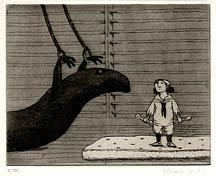
2 - Girl with Gymnasium Friend (shown at top of posting, not in my collection)
3 - Baby Transported  - I am showing #119/120, bottom of post
4 - Malocclusion (Teddy Bear on Cliff) - I am showing print #71/120, above right - This is one of my all time favorite Gorey images. "Malocclusion" means crooked or irregular teeth.
5 - Woman Beneath Rolling Elephant (shown small above right, not in my collection)
6 - Child and Elephant Table (shown small above left, not in my collection) - According to research done by Rick Jones, director of the Edward Gorey House, the common title for this print, Baby Seated Under Rolling Elephant is incorrect. The correct title appears in the original Diogenes brochure for the set of prints.

These six prints can be fairly difficult to acquire, and consequently tend to be somewhat expensive.


Sunday, March 27, 2011

Thoughtful Alphabets

While not technically "books", Edward Gorey's Thoughtful Alphabets were printed in 1996 as limited edition posters, or broadsides. The set consists of six alphabets, each hand lettered and illustrated with clip art images. This style of illustration seemed to appeal to Mr. Gorey at this time, and the graphic quality of the broadsides is strong.


The broadsides are titled on each poster as:
Thoughtful Alphabet No. 2
Thoughtful Alphabet
No. 3
Thoughtful Alphabet No. 4
Thoughtful Alphabet
No. 10
Thoughtful Alphabet
No. 14
Thoughtful Alphabet
No. 15

The 12" x 18" broadsides were published in two limited editions, and because of their size and graphic impact, they are suitable for framing.

Printed on white paper in an edition of 100 signed and numbered copies, this edition was sold as a set of 6 alphabets. I am showing one print from set #9/100.

Printed on brightly colored paper - each broadside is a different color - in an edition of 300 signed (unnumbered) copies, the colored broadsides were sold individually. Regardless of how they were originally offered, the Thoughtful Alphabet broadsides are now often sold as single "prints".

Friday, March 18, 2011

The Hand of the Necromancer

The Hand of the Necromancer was published in 1996 by Dial Books for Young readers. It is the first book in the "John Bellairs" series to be written entirely by Brad Strickland. Using characters and working on new plot lines inspired by John Bellairs, Mr. Strickland begins shaping the series solo at this point.
Once again, Edward Gorey has created a color wrap around dust jacket painting and a black & white frontis illustration for this title. While perfectly serviceable, Mr. Gorey's work on this book lacks a spark of inspiration and drama he exhibits on other titles from the series.

It is not unusual for a popular book series to continue after the death of the original author. L. Frank Baum wrote fifteen Oz books beginning with The Wonderful Wizard of Oz, published in 1900. Mr. Baum died in May 1919, and his two final books were published after his death (The Magic of Oz in 1919 & Glinda of Oz in 1920). In 1921, the publisher continued the series with author Ruth Plumly Thompson. Unlike the Bellairs series, Miss Thompson's first Oz outing, The Royal Book of Oz, was published under Baum's name. She would go on to publish 19 titles in the series. Another similarity between the Bellairs and Oz book series is the continuation of the illustrator (Edward Gorey for Bellairs, John R. Neill for Oz), giving the books a cohesive look after the change of authors.

For more information on the Oz book series, go to theozenthusiast.blogspot.com.

Monday, March 14, 2011

Fine Art Prints, Part 3

In 1986, Edward Gorey created a suite of collagraph prints entitled Elefantomas (hmm, sound familiar? Like Fantomas perhaps?). Housed in a cloth covered portfolio with ties, the set consists of 9 prints, plus a signed colophon page. Published in an edition of 26 lettered and 10 Roman numeral sets, Elefantomas is a quite scarce Gorey collectible. The images below show one of the lettered sets, and the photographs were sent to me by a collector.

The two editions are actually quite different from one another. For the 26 lettered copies, each print is signed and lettered individually to match the colophon page. The 10 Roman numeral sets consist of "ghost images" of each of the prints. These "ghosts" were achieved by laying a second sheet of paper on the printing plate once a print was pulled without re-inking the plate. The resulting prints are lighter and less well defined than the lettered edition. For the ten Roman numeral sets, only the colophon page is signed and numbered. The individual prints are not marked.

The art shows a figure with an elephantine head striking many different poses, and performing circus-style acrobatics. It has been remarked that this is Edward Gorey's most erotic artwork. Because the printing process reverses images, the lettering on the title print appears backwards.

Wednesday, March 9, 2011

Q.R.V. UNWMKD & HIKUPTAH Postcards

Q.R.V. UNWMKD.IMPERF,: A Dozen Dogear Wryde Postcards and Q.R.V. HIKUPTAH: A Dozen Dogear Wryde Postcards by Edward Gorey were published in tandem in 1996. Although the two sets were sold together as a single item, they are often broken up and sold individually today.
Issued in printed envelopes, each postcard set was limited to 500 copies (signed on the envelope, but not numbered) and 26 lettered copies. The lettered copies were hand stamped in the lower left hand corner by Mr. Gorey using an old fashioned alphabet capitol letter stamp. The stamped letters were then hand colored by Mr. Gorey. These stamps remind me of stamp sets I had as a child, and look like something that Mr. Gorey would have found in a yard sale. I am showing one of the signed sets and the lettered set "I".

Each of the 12 cards in the envelopes feature Q.R.V. verses which have been hand lettered by Edward Gorey. The accompanying images however are various "cut and paste" medical, advertising, insect, and miscellaneous images which can be found in numerous books of clip art. Often amusing, the images compliment the verses in unique ways.

Friday, March 4, 2011

An Interesting NYTimes Article

This article about Edward Gorey appeared in the New York Times.