Showing posts with label magazine. Show all posts

Sunday, March 29, 2026

A Gorey Comic Page

For the May 1966 issue of Esquire Magazine Edward Gorey was engaged to create illustrations for a two page spread authored by David Newman and Robert Benton entitled From Weehawken With Love

Founded in 1933, Esquire is an upscale men's magazine with a history of publishing articles and fiction by current authors. While it has featured the pin-up style illustrations of other magazines for men, Esquire is not a Playboy style publication showcasing nude photos of women. Edward Gorey was commissioned three times by Esquire in 1966. The February, May, and December issues all feature works created for articles in the magazine.

Robert Benton (1932 - 2025) worked at Esquire first as art director then as a contributing editor. David Newman (1937 - 2003) worked as an editor for the magazine when the two became professional writing partners who would be nominated for an Oscar as screenwriters for the 1967 film Bonnie and Clyde. Their professional partnership had continued success with screenplays and librettos for Broadway musicals until Benton turned his talents to directing films. Newman then collaborated with his wife Leslie Newman on screenplays for many Hollywood blockbuster films.

Benton and Newman were obviously navigating the complicated world of Hollywood screenwriting when they created this piece, as evidenced in the introduction panel under the title. They also were enjoying writing a humorous pastiche of the James Bond spy films. 

Edward Gorey was a self-avowed film addict who enhanced the story line by adding his own touches of suggestive humor to the drawings. Presented in a comic book format with captions appearing as speech bubbles in each panel, this piece also reads as a storyboard for a film. 

Responding to the parody story line, Edward Gorey draws an eccentric cast of characters including a scientist that has turned blue, presumably because of an experiment that did not go as planned. Mr. Gorey also alters his usual style for the hand lettered text to be "comic book" style rather than "Gorey" style. 
Adapting to the comic book format, Edward Gorey embraces the sex and violence spy theme. The drawings include nudity, an extremely voluptuous Femme Fatale, and bloody violence in his drawings. Agent Ilya Ipcress even appears completely disheveled after having sex with the secretary. Not typical Gorey illustrations, but a format and theme he obviously had fun illustrating.

As the cover of the magazine suggests, this is a comic full of Spying, Science, and Sex.

Photo of Benton and Newman (cropped) by Burton Berlinski 

Tuesday, January 17, 2023

The Kenyon Review

Published by Kenyon College in Gambier, Ohio, The Kenyon Review is a literary magazine that first appeared in 1939. Apart from a ten year lapse between 1969 and 1979, the magazine has been in print since its inception. In November 1966, artwork by Edward Gorey graced the cover of the magazine. Mr. Gorey also created illustrations for two stories within this issue.

The interior illustrations are fairly standard Gorey illustration work for the time. They are boldly rendered and eye catching, but look like much of his other book illustration work.

Reviewing the magazine covers Edward Gorey created over the course of his career, The Kenyon Review cover artwork stands out as one of his most successful. The image is finely detailed, yet still grabs the viewer's attention from a distance (to view all the magazine covers, reference my post from October 7, 2022 - http://goreyana.blogspot.com/2022/10/magazine-covers.html).

I recently acquired the original artwork for this cover design. The image shows a luxuriously bearded young man (a youthful Edward Gorey himself?) pausing on a stone terrace in his search for literary inspiration. Hovering over his left shoulder is an ethereal muse who, from the look of concentrated anticipation on the young man's face, is providing the longed for spark for his writing. Can the onlookers see the muse, or are they simply passing silent judgement at how woefully inadequate his clothes are for the obviously frigid temperatures? The scene is drawn in deep perspective, which gives the piece a theatrical atmosphere.

An artistic muse was clearly hovering about Edward Gorey himself when he sat down to create this piece. Using only black ink on white paper, this piece is a stellar example of Mr. Gorey's command of pen technique. The stone terrace and marble balustrade appear cold and solid against a forbidding sky that could produce rain or snow at any moment. The muse floats weightlessly while the figures in the background are stern and dark, adding no comfort to the scene. The thick black outline and encroaching branches give the sense that the viewer is observing the scene through a window.

Included with the original artwork were xeroxed copies of two pieces of correspondence relating to the piece. In early 1966 Edward Gorey was in conversation with editor Robie Macauley about the possibility of providing (unspecified) illustrations for the publication. On a postcard sent in March 1966, Mr. Gorey replies to Mr. Maculey about some "very odd" stories that were sent for consideration. He requests that back issues of the magazine be sent to him so he can get a feel for the publication and how they have used story illustrations in the past.

(note: the postcard chosen by Edward Gorey shows The Seventh Plague of Egypt by John Martin, 1800. The plague was a thunderstorm of hail and fire - https://collections.mfa.org/objects/33665)

The second piece of correspondence is a letter dated 15 September 1966 from Edward Gorey to editor George Lanning. This letter  accompanied the finished artwork. Typed on Mr. Gorey's distinctive typewriter, the missive gives an illuminating glimpse as to how the illustrator worked with editors and presented them publishing choices. This willingness to give options is no doubt a holdover from his days at Anchor Publishing. In the letter Mr. Gorey gives three options for how the cover image can be used. He states that he intended the image to be black and white, but is open to having some color added for the hair of the muse and/or the paper on which the young author is writing. He also provided extra hand-lettered pieces that could be pasted onto the image, just in case he didn't get the prices correct on the art (they were correct).

It is interesting to see how the focus of the drawing changes by dropping colors into the image as specified. On the whole, the first choice of a black and white image remains the most striking as the colors are more distracting than enhancing the image. 

Edward Gorey's relationship with editors was often personal and informal. At the end of the letter, he states that a blank bill is enclosed because he lost track of the payment details for the project. This shows a level of professional trust that seemed to exist between the artist and his clients.
 

Tuesday, November 8, 2022

The Insomniac's Garden

As discussed in a previous post, Edward Gorey created 34 magazine/periodical cover designs over the course of his career. Mr. Gorey's cover for the June 1984 issue of TWA's Ambassador Magazine is titled The Insomniac's Garden. Several artists contributed artwork for the feature "Gardens You Never Dreamed Of" inside this issue.

The Insomniac's Garden is a study in grey tones, and the overall coloration suggests that the garden might be located in northern Sweden where the sun never completely sets during the month of June (the month this magazine was issued). Since Ambassador is an airline magazine whose goal is to promote international travel, it is a witty commentary on travel by Edward Gorey, a man who only traveled outside the United States once in his life. 

A pale midnight sun hangs in a washed grey sky over a garden surrounded by a high wall along which unkept topiary runs rampant. A sleeping cat lies on top of the wall, undisturbed by the perpetual twilight. A single tall column topped with an urn rises from the center of a garden maze that has either been recently planted or is stunted. 

A solitary woman in a long nightshirt wanders forlornly within the maze, her gaze distracted, her steps faltering. Our fretful insomniac lives in this nightless world where all colors are reduced to one tone. The only non-grey color in the piece is the woman's skin and the pink ears and red eyes of her bunny slippers. These pink tones are mimicked in the line of type at the top of the cover.

At 8.5" x 11" (image size on larger board), this is a large color painting for Edward Gorey. The layout is quite sophisticated and showcases Mr. Gorey's consummate skill as a graphic artist. The piece was carefully composed with space for all of the required elements of the magazine's cover. It is a true test of Mr. Gorey's skill as an illustrator to note that the image is equally satisfying when viewed as a magazine cover or as a painting without the type.

When I acquired this wonderful piece of art, I was surprised to find that: 

A) it was painted on illustration board - a somewhat unusual substrate for Edward Gorey to work on.

B) The front surface of the board with the painting had been professionally removed from the board itself with the utmost precision. This difficult technique is usually employed when a piece is in need of preservation, but this was done when Mr. Gorey sent the art to the magazine and was returned to him in this condition.

To unravel the mystery of why the painting would have been removed from the surface of the board we have to examine image reproduction methods and machinery used in the magazine industry in the 1980's. Like most travel oriented magazines, Ambassador was primarily illustrated with photos and the highest quality technology at the time to scan an image for printing was to use a drum scanner (https://www.pcmag.com/encyclopedia/term/drum-scanner). Photos, transparencies, or artworks needed to be wrapped around the drum of the scanner and Edward Gorey's artwork was painted on illustration board. The only way to wrap the painting was to remove it from the surface of the board by cutting the painting from the backing. The other paintings in the feature were photographed for reproduction and (according to one artist) poorly reproduced inside the magazine. Being the cover of the magazine, the Gorey image would be given special treatment.

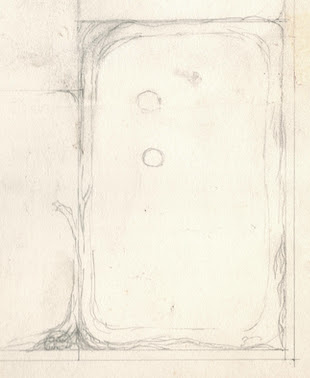
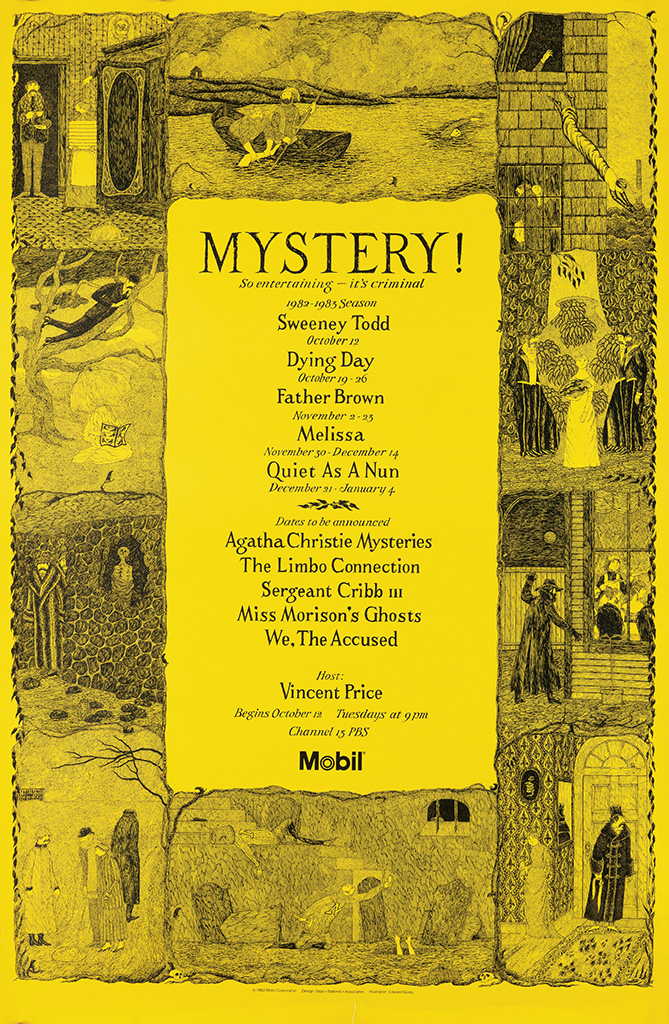
The back of a piece of artwork often tells its own story and the back of this piece is no exception. Like most artists, Edward Gorey occasionally exhibited a frugal streak when it came to reusing papers and boards. For this piece, he chose a board on which he had begun to block out a poster design for Mystery! The board has been cut down for this project, but the divisions for the vignettes are clearly indicated and the beginnings of a decorative border has been sketched in on the lower right.

This poster design would be used for several seasons of Mystery! with the central block of type changing for each season.


Sunday, October 16, 2022

Edward Gorey's Magazine Covers Part 2 - The Full Color Covers


As discussed in the previous post, over the course of his career Edward Gorey created a total of 34 published magazine covers. Only 8 of the 34 covers were conceived as full color paintings, the rest being black and white drawings that sometimes had some color dropped in, or colored backgrounds added.  

In addition to the eight published color covers, there are also four unpublished full color designs.


Edward Gorey's first black & white magazine cover was published in 1950 by the Harvard Advocate, but it was not until the December 1971 issue of National Lampoon that a full color Gorey cover would appear. Unlike many of his previous black and white designs for other publications, this clever and amusing illustration lacks a bold visual appeal. The muted tones and block of small type appears fussy, and the dreary subject, while amusing, is not an endearing holiday image.   

The playful May 1975 Publishers Weekly cover is the boldest full color cover of the 1970's. With this cover, Edward Gorey hearkens back to his work for Anchor Publishing, and creates an illustration that incorporates all aspects of the magazine cover into a singular image. The masthead, logo, and typeface are reflected both in color and style on the wings of the flying figure, and the overall layout is conceived as a single Gorey-designed piece. The use of small speech bubbles would be more appropriate for an interior illustration than a cover image, but the design has a strong graphic sensibility. 

The June 1975 issue of National Lampoon has a better conceived cover image than the December 1971 Lampoon cover, but it still does not take full advantage of its prominent position. While Edward Gorey rarely used speech bubbles in his own work, he cannot seem to leave them off his color cover designs. Interestingly, the use of speech bubbles does not appear on any of his black and white magazine cover designs (see previous post for images).

1983's cover illustration for Radio Shack's Hot Coco magazine looks even more like a panel cartoon than the National Lampoon covers. This is mainly due to the artwork's placement on the cover, and the large speech bubble. With an Edwardian family discussing the merits of a color computer (CoCo stands for Color Computer), the image is colorful and humorous, but the layout of cover as a whole is pedestrian and unimaginative. The image itself is expertly rendered with painted details intermingling with line work to create different textures and surfaces. The use of color in this piece is subtle and quite beautiful.

Edward Gorey finally comes into his own with the June 1984 TWA Ambassador Magazine color cover. Titled The Insomniac's Garden, this piece is one of several "fantasy garden" images created by different artists that are featured within this issue. The drawing has been designed by Mr. Gorey as a complete concept, with room for the masthead and typography accommodated within the illustration. The design is bold, eye catching, and completely visual. Gone are the cartoon caption bubbles, leaving the viewer free to muse on the image. The piece is a subtle study in grey tones, with the occasional pinpoint of color to draw the eye.

Gracing the cover of the February 1988 issue of Print Magazine is another breakthrough design that fully celebrates Edward Gorey's talents as a magazine cover illustrator. The colorful painting explodes with imagination and Mr. Gorey's enigmatic visual humor. The image is accessible, yet delightfully puzzling.

In 1992 Edward Gorey submitted two full color pieces to The New Yorker for consideration, one of which was published as the cover of the December 1992 holiday issue. Papering the Tree would be the last color magazine cover by Mr. Gorey published during his lifetime. Once again, the artist has created a colorful, stimulating image that is full of humor. Instead of wrapping presents to put under the tree, this extended family is wrapping the tree itself - and the cat & dog.

Submitted to The New Yorker magazine in 1992 along with Wrapping The Tree, Cat Fancy was set aside by the editors to be virtually forgotten. Rediscovered many years after Edward Gorey's death, this masterpiece work would finally appear on the cover of the December 2018 holiday issue. Layers upon layers of fabric, pillows, dust ruffles, and duvets adorn an overstuffed bed whose inhabitants are a pair of reclining cats. 

Unpublished Cover Designs

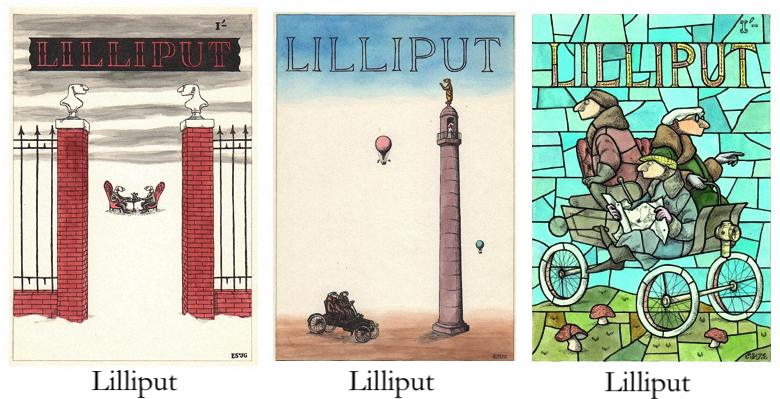
Gorey's earliest full color magazine covers were created for Lilliput Magazine, a British publication that combined humor with daring photos of unclad women. These paintings were created in the late 1940's/early 50's, and it is not known if these designs were actually submitted to the magazine for consideration. Each of these eye catching illustrations has well balanced images and a sophisticated use of color. The Lilliput designs were never published, and these three pieces of original art are in my personal collection.

Finally, along with the three Lilliput images from the 1950's, a fourth unused full color cover design was created by Edward Gorey in 1993. Flappers and Topiary is an imaginative image that, like Cat Fancy, was set aside by the staff at The New Yorker when it was submitted to the magazine in 1993. This image has yet to appear on the magazine's cover, but it was published as a full page memorial in the magazine shortly after Mr. Gorey's death.

Cover images provided by Irwin Terry, Sam Spiegel, Swann Auction Galleries, Internet Search


Friday, October 7, 2022

Magazine Covers


As a freelance illustrator, Edward Gorey created images for a wide variety of publications including books, newspapers, catalogs, and magazines. As early as 1950 Edward Gorey's artwork graced magazine covers, but they would not appear with any frequency over the course of his career. The sporadic nature of his cover appearances is likely because Mr. Gorey was primarily a book illustrator and that is where his energies were focused. While he produced hundreds of images for periodicals, Mr. Gorey created 34 images specifically for use as magazine covers. In addition, there were 5 images that were intended but never published as magazine covers. The relatively small number of Gorey designed magazine covers can be compared to Charles Addams, who created 64 covers for The New Yorker magazine during his career.  


These pictured groupings bring together all the known Gorey designed magazine covers (missing covers will be filled in as images turn up). Over the years, other images by Edward Gorey were hijacked and put onto the covers of magazines, but those images were not intended as cover designs so they have not been included here. 

Cover images provided by Irwin Terry, Sam Spiegel, Swann Auction Galleries, Russell Lehrer, Todd Camp, Internet Searches.


Tuesday, September 6, 2022

The Harvard Advocate Covers

It has long been stated that the cover of the September 1950 issue of The Harvard Advocate (HA) is the first Edward Gorey illustration to appear in a published work. However – while researching Mr. Gorey's periodical cover designs, I ran across the April 1, 2021 Ashcroft and Moore (A&M) auction listing for this particular magazine. The A&M auction sold the remnants of Andreas Brown's Gotham Book Mart inventory, and Lot 44 included a second, very seldom seen HA cover design by Mr. Gorey.


The September 1950 Registration issue is well documented and, while very rare, occasionally appears for sale. The 1950 Commencement issue is virtually unknown on the market. Looking at the titles of the two magazines, the natural assumption is that the registration issue was created/published first, and the commencement followed. Yet both are dated 1950; how can a publication that follows a single academic year have both issues published in the same calendar year? The answer lies within the magazines, on the Table of Contents pages. Fortunately, A&M scanned these pages and presented them as part of the auction listing.

The table of contents/information page in both copies states that the HA magazine was "Published six times a year in Sept., Nov., Dec., Feb., Mar., & May". The page in the Registration Issue clearly states that this is the September 1950 issue and is No. 1 (for the 1950/1951 academic year). The other issue does not specify the publication month, but says "COMMENCEMENT ISSUE, 1950, No. 6". This means it is the final issue of the 1949/1950 school year, and would have been published in May 1950; consequently making it the first published appearance of illustration work by Edward Gorey.

This is confirmed by the Volume numbers of CXXXIII in the Commencement, and CXXXIV in the Registration issues. It is also of interest that Edward Gorey is listed as Edward St. J. Gorey both issues.
 

Thursday, March 31, 2022
Edward Gorey's Early Published Writing


I was recently contacted by Karen Roth, a fellow Edward Gorey enthusiast who did some detective work after reading my blog post about the publication of Saint Melissa the Mottled (November 3, 2012). In this post, I pondered if SMtM was the only example of Edward Gorey's college era prose writing to appear in the Radcliffe College publication Signature at that time.

Ms. Roth found that the Harvard University Library has digitized issues of Signature from 1947 - 1950 and that there are in fact three short stories and three poems by Edward Gorey published in the magazine. Saint Melissa is actually Mr. Gorey's fourth piece to appear in print.

  • Temperaments (poem, Vol. 2 No. 5, April 1948) 
  • On The Ultimate Evening Of Your Earthly Existence (poem, Vol. 4 No. 1, Fall 1949) 
  • All That First Evening (story, Vol. 4 No. 1, Fall 1949) 
  • Saint Melissa-the-Mottled (story, Vol. 4 No. 2, Winter 1949) 
  • Sonnet (sonnet, Vol. 4 No. 3, Spring 1950)
  • To Start On A Journey Is To Reach Its End (story, Vol. 4 No. 3, Spring 1950)

All of the pieces are credited as being written by Edward St. John Gorey except the first, Temperaments which is credited as Edward Gorey. To peruse the magazines and read all of Mr. Gorey's writings for Signature, go to this link: https://iiif.lib.harvard.edu/manifests/view/drs:35365546$1i

It is unfortunate that Signature did not ask Edward Gorey to create any illustrations for the publication.


Tuesday, October 5, 2021

Goreyana's 13th Anniversary


2007/08 was a dark time for Edward Gorey collectors. The Gotham Book Mart, the mainline source not only for Gorey books, merchandise and original artwork, but also for information had closed permanently in 2007. Most book dealers would have a few Gorey items in stock, but there was no longer a centralized location for information and collectors were for the most part on their own, clinging to their 1996 copies of Goreyography by Henry Toledano and old catalogs from various book dealers and auction houses for reference. The seminal Elegant Enigmas traveling exhibition would not materialize until 2009, and the only physical location to experience the works of Edward Gorey was The Edward Gorey House in Yarmouth Port, Massachusetts.

As a way to re-energize myself and reconnect with my collection, I created this Goreyana blog on October 5, 2008. My intention was to show pieces from my collection, inform interested parties about Gorey happenings, pass along many of the stories that I had gathered over the years and hopefully begin conversations with others interested in Edward Gorey and his works. Thirteen years of diligent posting have not dampened my curiosity and enthusiasm for all things Gorey and I look forward to creating upcoming posts that everyone will find informative and entertaining.

- Irwin Terry

goreyana.blogspot.com

ampootozote@aol.com


Sunday, September 19, 2021

Gorey Collectors Share


Collecting the works of Edward Gorey can be approached from multiple viewpoints. Pick a collecting category: books by Gorey, original artwork, prints, posters, periodicals, books illustrated by Gorey, Anchor covers from the 50's, theater, dance, foreign editions, and the list goes on. Mr. Gorey was so prolific that anyone can easily specialize in one or two areas and always find something fresh to excite them.

Traditionally, collecting has been a solitary endeavor with collectors privately enjoying their treasures while keeping their collections private. There has been a change in the ozone in Goreyland recently. Perhaps it was the pandemic shutdowns that led collectors to begin more openly engaging with other collectors, sharing the pieces they love on Facebook and Instagram. The Edward Gorey Charitable Trust began regularly sharing pieces from the Gorey archives on social media in August 2019. The result of all this activity is that there is more specialized information available to those interested in the works of Edward Gorey than ever before, which is never a bad thing.

To view or contribute to the fun that is Gorey collecting, join Facebook Groups: Edward Gorey and/or Edward Gorey Fans, and follow The Edward Gorey Charitable Trust. A increasing number of collectors have been showing pieces from their collections, which leads to interesting conversational threads.

On Instagram:

edwardgoreytrust - Images from the Edward Gorey Archives are posted regularly, many of which have not been seen before outside of the archive.

toddcamp - Todd Camp posts images and in-depth explanations of pieces from his collection which he has dubbed the Goreyphemera Archive.

edgoreyfashion -An interesting collection of Gorey images paired with real life fashion, past and present.

edward.gorey - Drummond Miles shows off a variety of objects and artworks.

edward.gorey.house - Keep up with the latest happenings in the Gorey world and see images from current exhibitions at The House.

There are, of course other places to find posts and information on the web, but these places are great places to see interesting things.


Monday, August 24, 2020

Plunger Artwork


The recent Illustration Art auction at Swann Auction Galleries offered six lots of original artwork by Edward Gorey. The lots represented three distinct drawing styles practiced by Mr. Gorey - the classic finely detailed pen & ink drawing, a loose watercolor painting style, and Mr. Gorey's "cartoon" style.

Edward Gorey often worked in the cartoon style for pieces that would appear in magazines, poster designs, and newspapers. The look is bold and less detailed than his traditional drawing style for a reason - these images would be printed smaller or considerably larger than the artwork itself and for the image to "read" properly the details are simplified. The cartoon style often includes shots of bright watercolor details that would make the image "pop" on the page.

Two pieces included in the sale were (most likely) created for The Harvard Review. Each drawing shows formally attired people with brightly colored plungers presumably covering holes in the floor and walls. The first drawing shows a man and a woman working to plug up holes in a confined space, while in the second two couples are being menaced by giant snakes as they work. The attire and look of the people in both drawings calls to mind 1960's British "mod" fashions which Edward Gorey often used to costume people in his magazine illustrations. The first, smaller vertical drawing is now in my personal collection.


Monday, June 17, 2019

TV Guide Soap Opera Artwork


The Illustration Art auction that took place last week Swann Auction Galleries had a wonderful selection of works by Edward Gorey. Lot #138 was a delightful full color painting that appered in the May 10, 1986 issue of TV Guide. From 1977 through 1993, Mr. Gorey created numerous pieces for the weekly television guide, almost all of them in color. As a general rule, Edward Gorey preferred to create drawings at the size they would be printed. Due to the small format of the magazine, all of the TV guide pieces were drawn/painted larger and were reduced in size to fit the page.

For his TV Guide pieces, Edward Gorey let his playful sense of humor come to the forefront. Mr. Gorey was an avid television viewer who thoroughly enjoyed sitcoms and soap operas. For this piece, the entranced viewer has the wide eyed blank stare of a person who has spent many hours following too much trauma/drama on the television set. The speech bubble is a parody of dialog and the acting abilities of the soap's actors. The wording has been pasted onto the surface of the artwork, indicating that Mr. Gorey's changed the text after completing the artwork. It would be interesting to compare the original wording with the final text.