Friday, June 10, 2022

Gorey Original Artworks

There have been a couple interesting pieces of original art by Edward Gorey to come onto the market recently. The June 9th Illustration Art Auction at Swann Auction Galleries in New York City featured an unusual piece titled A Song and A Poem for A. The artwork was created as a cover illustration in 1973 for a limited edition, staple bound book of poetry by Richard Elliott. 

The image is a variation on a children's cut and paste toy where a box can be created by cutting out and pasting it together using the indicated flaps. Throughout his career, Edward Gorey created drawings with missing figures. This piece takes the concept a step further by providing the figures and objects to cut and paste into position on the box. While it is hard to imagine anyone actually cutting up the cover of the booklet, the viewer is engaged by visualizing the process, just as one is engaged with the writer by reading and reflecting on their poems.

During a virtual bookfair in April, The Edward Gorey Charitable Trust released an early piece of artwork. Promoted on their social media platforms, this piece was sold to benefit the mission statement of the Trust. A most unusual piece, the art is a blend of modern art and traditional New England imagery. Life, death, mourning and the afterlife are represented poetically in this image.


Tuesday, May 17, 2022

The Bellairs Archive, Part 4 - The Figure in the Shadows

The House With A Clock In Its Walls was published in the summer of 1973 and was a success for author John Bellairs and Dial Publishing. The publisher was eager for a second book from the author and Mr. Bellairs was busy writing two manuscripts for consideration, the first being a sequel to House and the other a stand alone story for teens. The success of House meant that the stand alone story eventually was set aside and The Figure In The Shadows, which was intended as the central book in The Lewis Trilogy, became the priority project. Anxious to repeat the success of the first book, Dial retained Edward Gorey to illustrate this title.

A Halloween deadline was agreed upon for the author to submit a completed manuscript. A letter dated September 23, 1973 to the editor begins:

By April 1974, the manuscript had been completed and had been forwarded to Edward Gorey. There was now a new editor working on the Bellairs' project as Mrs. Gavril was on maternity leave. On April 25, 1974, Senior Editor Regina Hayes wrote with ominous news concerning the Gorey illustrations:

The June 14th report from Dial:

And finally, on August 27th Dial sent this to the author:

John Bellairs reply a few weeks later:
Victoria Chess did submit examples of her work for consideration, but Dial was not overly enthusiastic with her samples. This, coupled with the fact that Ms. Chess was currently living in Lebanon which would have complicated the logistics, eliminated her from the project. By the end of September illustrator Mercer Mayer was engaged to illustrate Figure.

Why didn't Edward Gorey come through with the illustrations for this book? While there is no first hand explanation in the Bellairs Archive, there are several factors that would have certainly influenced his decision to withdraw from the project. 

1973 had been an exceptionally prolific year for Edward Gorey wherein he published six of his own books, completed illustration projects for other authors, wrote movie reviews for The Soho Weekly News, and designed the sets and costumes for a production of Dracula in Nantucket that would move to Broadway in 1977 on the strength of his designs. 

A large portion of Edward Gorey's time and energy in 1974 was taken up with two major exhibitions of his work. The Graham Gallery in New York City exhibited new works by Edward Gorey, showing forty-six pieces created expressly for the show. This was Mr. Gorey's first fine art gallery show. He would participate in only two other gallery shows of his art (also at Graham), but these shows would feature far fewer new works and be filled in with art he created for his books.

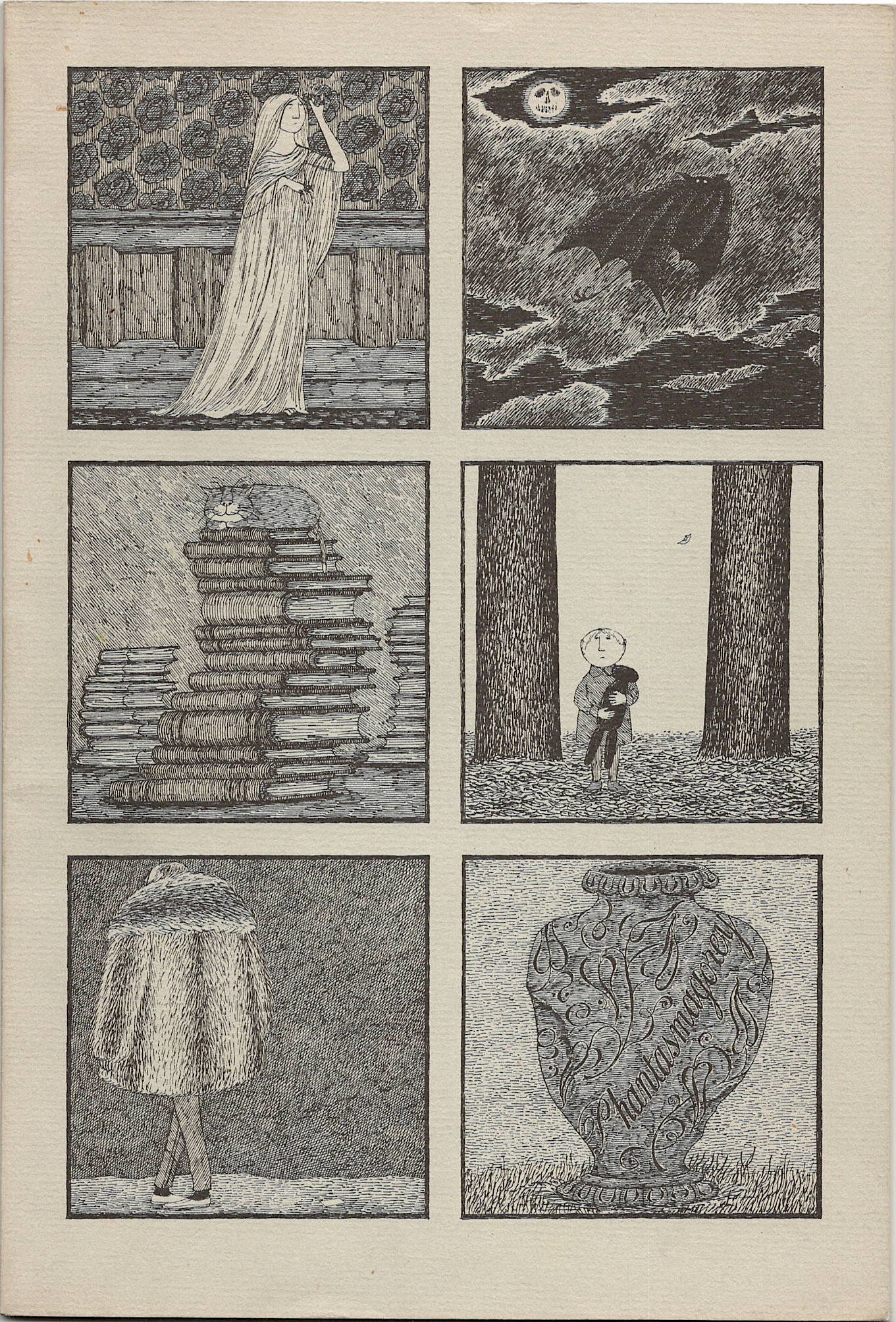
Mr. Gorey also agreed to the first major retrospective exhibition of his works. The exhibition was titled Phantasmagorey and was mounted at Yale University. 

All of these factors came together making 1974 a year where Edward Gorey did not publish a book of his own* and he took on very few illustration projects. Some illustration projects fell to the wayside and The Figure In The Shadows was one of those projects. 

*CATEGOR Y has a publication date of 1974, but only due to printing/binding delays. All of the prep work for this title was completed in 1973.


Tuesday, May 3, 2022

The Bellairs Archive, Part 3 - Edward Gorey

Jean Gavril, Senior Editor at Dial Books informed author John Bellairs on June 1, 1972 that Edward Gorey had been contracted to illustrate The House With A Clock In Its Walls. From this point onwards, the production and publication of the book was dependent upon Edward Gorey completing the artwork.  

In a letter dated August 10, 1972, Mrs. Gavril writes:

Unfortunately, the expectations of the publisher expressed in this letter that they would receive sketches to approve were a bit optimistic. Edward Gorey was quoted in more than one interview to state that he really didn't collaborate in the traditional sense. After accepting a commission Mr. Gorey would read the material, decide what to illustrate based on his response to the writing, then sent the completed artwork to the publisher. He would rework or redraw an illustration if there was an issue with an image, but he usually just got to work and submitted the finished artwork without a lot of back and forth feedback.

The next mention of artwork comes in a letter dated November 10, 1972:

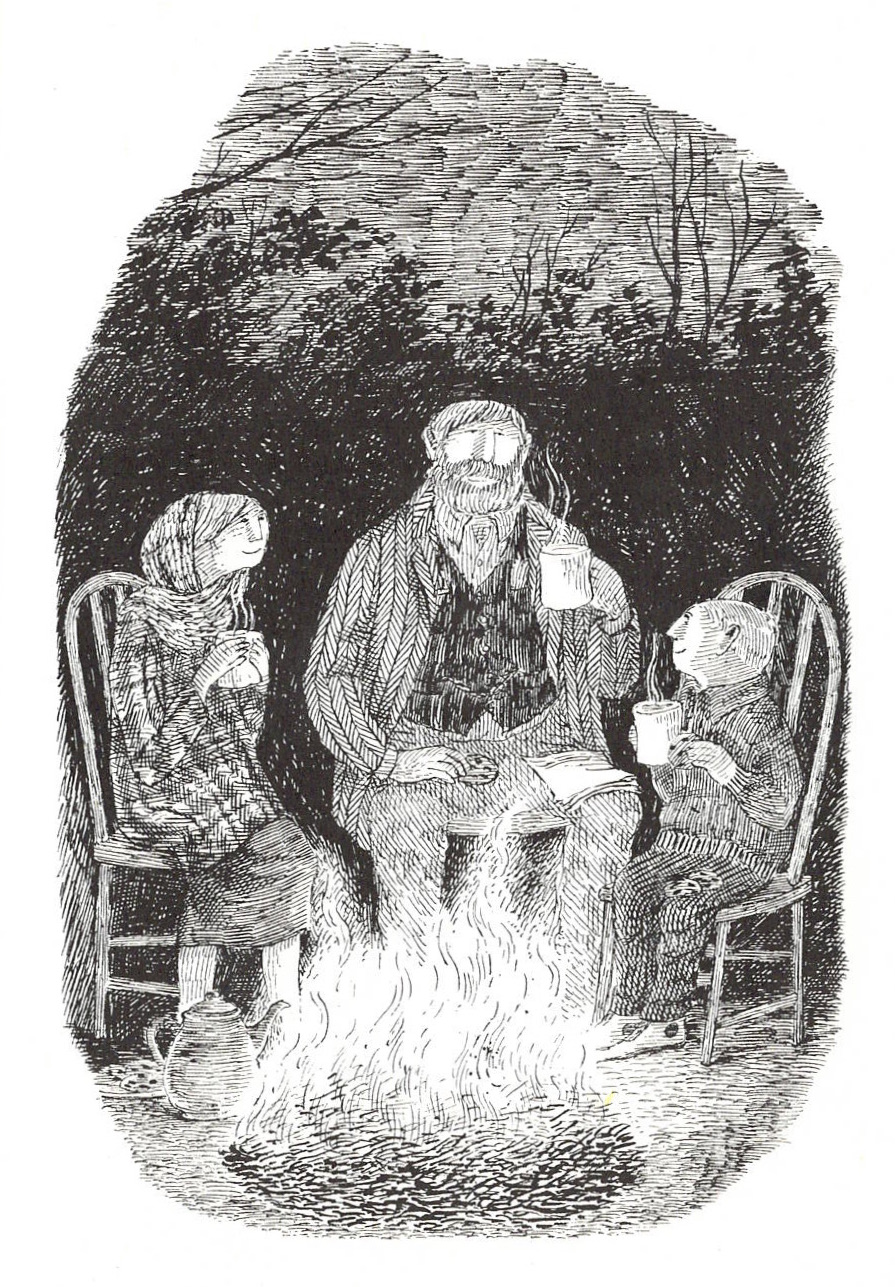
The * refers to a hand written p.s. stating that the art had already been sent to the printer but describes the drawing, "it's the final bonfire scene + it's smashing, complete with chocolate chip cookies."
This letter also confirmed that the author would receive official notification from Dial about the royalty change in his contract. Mr. Bellairs' originally agreed upon 10% royalty "will be divided with Edward Gorey on the basis of 9%-1% split." This news was most likely not received by the author with enthusiasm and probably reinforced the need to hire a literary agent to represent him, which he secured by April 1973. 

By December 14, 1972 Edward Gorey had completed the wrap around cover/dust wrapper design for the book:

In the 1990's I saw the original artwork for the House cover/DJ and remember it as being not so much drawn as composed. The various floating elements were individually drawn, cut out and pasted in place on the master drawing. Edward Gorey drew the art for the book at the finished size it would be printed and this piece was quite impressive in person.

The first few months of 1973 yielded no additional drawings from Edward Gorey and everyone was getting edgy as the publisher had been promoting and taking orders for the book and were anxious to get the presses running. 

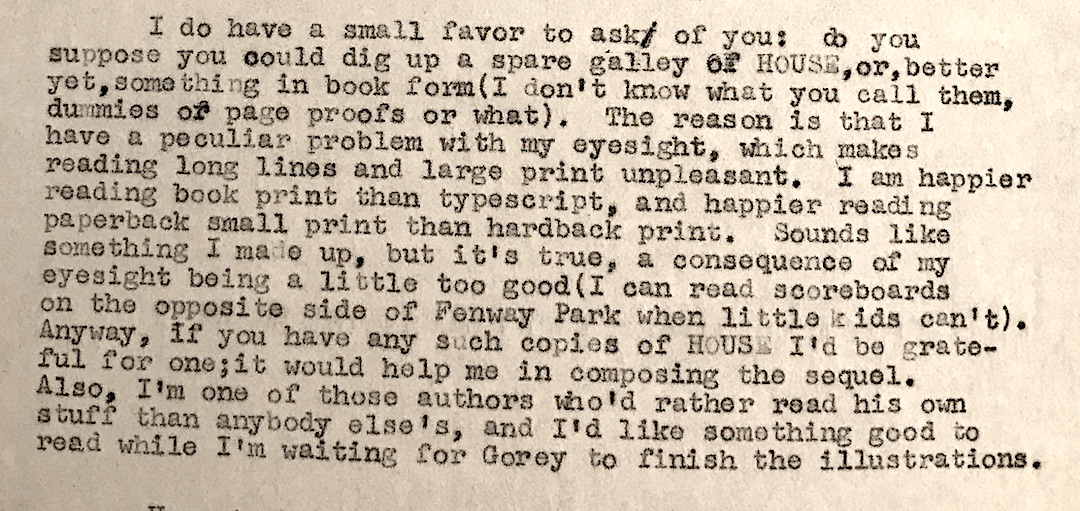
Over time, the letters between author and editor had become increasingly personal as their working relationship progressed. In his letter dated February 26, 1973, John Bellairs adds an interesting personal note on his request for a reading copy of House:


Crossing one another in the mail, this letter was sent to John Bellairs on February 28, 1973:


March 16:


And just shy of one year after Edward Gorey was contracted to illustrate The House With A Clock In Its Walls, this letter was sent to the author on April 18, 1973:


An amusing July letter regarding the House artwork reads in part:


This is the chapter title drawing that flummoxed the editor:

The remaining letters in the folder referencing House discuss how the book is being received and reviewed, but most of the content is related to notes for the second book in "the Lewis Trilogy". A mention in an earlier letter following a Dial sales conference congratulates the author on the positive prepublication reception House was receiving for the story itself and "not just the Gorey illustrations".

Coming next: Edward Gorey signs on for book 2.


Monday, April 25, 2022

The Bellairs Archive, Part 2 - The House with a Clock Gets an Illustrator


Did author John Bellairs ever meet illustrator Edward Gorey? The answer is a firm "No". It also appears that they also did not personally communicate directly with one another. Fans of Mr. Bellairs' book series may find this disappointing, but this is the usual working relationship between most authors and illustrators, especially on an author's early books where they have yet to achieve recognition and influence. Mr. Bellairs had previously published three adult novels, but had not published a book for teens.

John Bellairs submitted his manuscript for The House With A Clock In Its Walls to Dial Books early in the summer of 1971. After several revisions to the manuscript based on the publisher's feedback, Dial made an offer to publish the story (with the caveat that further revisions would be suggested). On November 15, 1971 Mr. Bellairs returned the signed contracts along with a brief letter asking if they intended to have the book illustrated. Here is part of that letter:

Note: In a 2018 interview (audio only), Priscilla Bellairs says that her husband used an old manual typewriter for his correspondence and stated that he really was a poor typist. The above sample certainly supports this statement. Mrs. Bellairs typed all the final typescripts for his manuscripts on an electric typewriter.

Senior Editor Jean Gavril was in charge of the House manuscript at Dial and she responded favorably to this suggestion, but she was unfamiliar with Marilyn Fitschen's work and requested that samples be forwarded to Dial. Presumably these were sent, but there is no written record in the university archive confirming this.

Subsequent letters in the file make no mention of an illustrator for House until this note from the editor dated June 2, 1972:

Up until this time Edward Gorey appears to have illustrated only one book published by Dial, and that was in 1965. Mr. Gorey did have a solid reputation and would have been considered something of a catch as an illustrator, but it is unclear from the letters in this archive how he was engaged to illustrate House. In her recorded interview, Priscilla Bellairs states that everyone was very excited that Mr. Gorey was going to work on the book because his name and talents would increase potential sales.

The next post will continue the tale of Edward Gorey's involvement with The House with a Clock in its Walls.


Friday, April 8, 2022

The Bellairs Archive, Part One


On a recent stroll through cyberspace, my husband Bill ran across the listing for an archive of manuscripts and correspondence by author John Bellairs housed in the special collections of The Kerlan Collection in the Anderson Library at University of Minnesota, Minneapolis campus. 

The online library listing is "specifically vague", only stating the archive includes manuscripts for all but two of Mr. Bellairs books and includes correspondence in "two boxes". The materials can be researched by appointment only and are not viewable online. Since the library is less than half a mile from our home, we secured a research appointment and were able to spend some time viewing the materials first hand. 

As is always the case with this type of material, it is exciting to open the treasure chest (or cardboard file boxes) and discover a time capsule of information waiting to be studied. The folders included everything from several early signed contracts, numerous letters to and from Mr. Bellairs to his publishers and editors, typed manuscripts, several galley proofs of books, and a lovely folder with some personal correspondence, photographs and artwork from fans. The photo of Mr. Bellairs at his writing desk (top of this post) is a particular favorite that was found in this folder.

The folders also include correspondence illuminating how Edward Gorey came to illustrate The House With A Clock In Its Walls and why he did not illustrate books 2 - 4 of the series, but that will be revealed in a future post!


Thursday, March 31, 2022

Edward Gorey's Early Published Writing


I was recently contacted by Karen Roth, a fellow Edward Gorey enthusiast who did some detective work after reading my blog post about the publication of Saint Melissa the Mottled (November 3, 2012). In this post, I pondered if SMtM was the only example of Edward Gorey's college era prose writing to appear in the Radcliffe College publication Signature at that time.

Ms. Roth found that the Harvard University Library has digitized issues of Signature from 1947 - 1950 and that there are in fact three short stories and three poems by Edward Gorey published in the magazine. Saint Melissa is actually Mr. Gorey's fourth piece to appear in print.

  • Temperaments (poem, Vol. 2 No. 5, April 1948) 
  • On The Ultimate Evening Of Your Earthly Existence (poem, Vol. 4 No. 1, Fall 1949) 
  • All That First Evening (story, Vol. 4 No. 1, Fall 1949) 
  • Saint Melissa-the-Mottled (story, Vol. 4 No. 2, Winter 1949) 
  • Sonnet (sonnet, Vol. 4 No. 3, Spring 1950)
  • To Start On A Journey Is To Reach Its End (story, Vol. 4 No. 3, Spring 1950)

All of the pieces are credited as being written by Edward St. John Gorey except the first, Temperaments which is credited as Edward Gorey. To peruse the magazines and read all of Mr. Gorey's writings for Signature, go to this link: https://iiif.lib.harvard.edu/manifests/view/drs:35365546$1i

It is unfortunate that Signature did not ask Edward Gorey to create any illustrations for the publication.


Tuesday, March 22, 2022

Auction News: The Happy Ending

Edward Gorey's original artwork for The Happy Ending sold at Doyle Auction House in New York City on March 22, 2022 for $20,160.00 (hammer price plus buyer's premium). This exceptional full color piece was published 49 years ago in the March 1973 issue of National Lampoon Magazine. This was the "cover" for Mr. Gorey's five page spread that also included 12 black and white single panel cartoons (see my post from July 29, 2013).

The beautifully rendered image was very poorly printed in the magazine. In the print version, Edward Gorey's careful modulation of color was ignored and a sickly yellow green tone insinuates itself throughout the image. The shift in color flattens the painting, altering the focus and destroying the dramatic power of the piece. This is a prime example of how an artist's intent can be destroyed by insensitive reproduction.

The Doyle listing notes that this piece was consigned by the estate of Kathryn Graham. Ms. Graham (1947 - 2020) was a psychotherapist with a masters in social work. In 2005, she published a lengthy essay titled The Devils Own Art: Topiary In Children's Fiction (Children's Literature, Volume 33, published by Johns Hopkins University Press). Alongside several contemporary illustrators and antecedents, Edward Gorey's use of topiary in his works is discussed. The full essay can be read here:

https://vtechworks.lib.vt.edu/bitstream/handle/10919/25442/33.1graham.pdf?sequence=1