Monday, January 2, 2023

The Wretch Comes To Life


My husband Bill likes to make all kinds of toys and figurines. For the past few years he has been surprising me with an Edward Gorey inspired creation for my birthday or our anniversary, both of which fall at the end of the year. The first figure he made depicts a scene from The Unstrung Harp where Mr. Earbrass is playing croquet in a snowy winter landscape. This figure is a traditional "smoker" (an incense burner) that when lit his breath comes out as smoke through his nose. The second is based on a Christmas card of an Earbrass man balancing piles of wrapped packages. When moved, he shakes and tips and the contents of the boxes rattle.

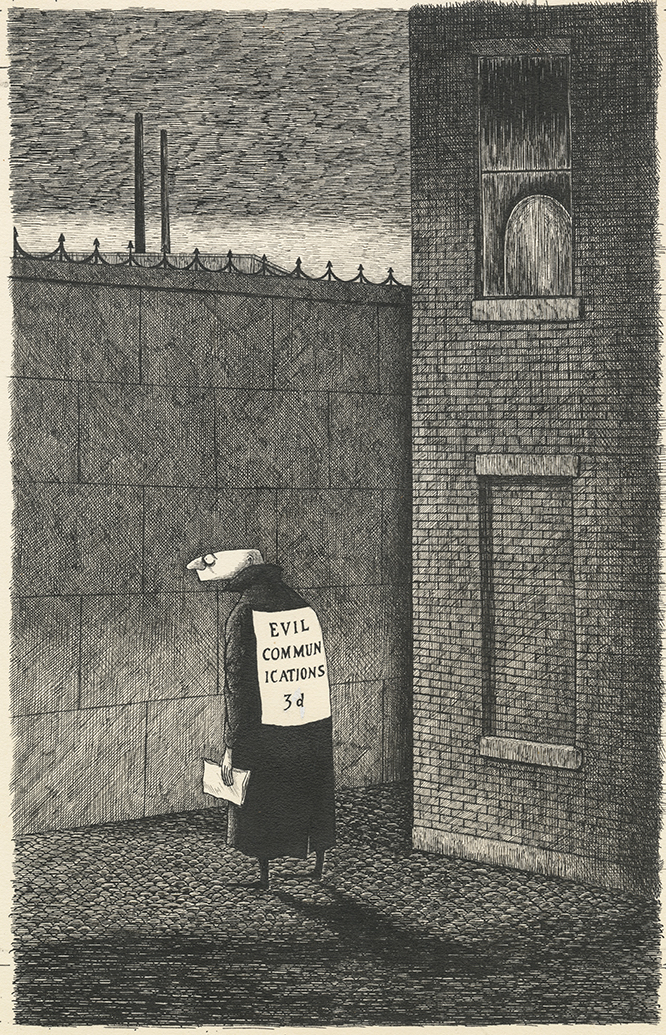
This year, Bill created a figure based on a piece of art I recently acquired depicting the Evil Communications character called The Wretch (see my previous post).

The Wretch is seen wandering the streets trying to sell his dubious pamphlets. There are piles of discarded pamphlets scattered at this feet, thrown back at him by disgruntled passersby. The Wretch's head can be turned and when bumped or moved, he waves the pamphlets as he flails his arms back and forth. As an added marketing tool for his propaganda, Bill made him so that the sign on his back lights up and changes colors. The short video shows how this unique gift was appropriately wrapped and revealed!


Tuesday, December 20, 2022

Evil Communications - The Wretch

A recent addition to my Edward Gorey original art collection is Evil Communications. Created around 1950, the piece shows a downtrodden individual dressed in an oversized coat, wandering about trying to distribute the aforementioned leaflets at the price of three cents each. A large advertisment is affixed to the back of his coat. The figure floats off center on an appropriately cockeyed sheet of art paper.

The drawing is beautifully rendered by Edward Gorey in a combination of extremely fine line work combined with loose sketching, giving the drawing a visual freshness that is typical of much of his early works.

This is not the only appearance of the hapless peddler. In at least two other instances from the same time period, Edward Gorey placed this character into unfinished/unpublished works. In The Angel, The Automobilist and Eighteen Others (completed in the late 40's, early 50's but not published until 2020 by The Edward Gorey Charitable Trust through Pomegranate), the character is seen wandering a cobbled street in a dense fog and has been given the moniker, The Wretch. Since there are no visible leaflets in this vignette, it is possible that the Wretch is dispensing verbal communications rather than leaflets, albeit at a higher price.

Another unpublished work from the same time period shows the Wretch, leaflets in hand, wandering down a dreary street in what is clearly a polluted industrial area. This beautifully rendered pen & ink drawing is meticulously detailed and full of atmospheric lighting effects. It is a true masterwork showing Edward Gorey's command of his chosen artistic medium. This is one of two pieces of existing artwork from The Bootless Foot. It is possible that the drawing of the single figure against the white background was intended for this same book, possibly for use as a spot illustration or on the title page.

(Unpublished images courtesy The Edward Gorey Charitable Trust)


Thursday, December 15, 2022

Auction News - Swann Illustration Sale

Swann Auction Galleries held its semi-annual Illustration Art Auction on Thursday December 15. Always highly anticipated, the auction featured 250 lots of original artwork, including five pieces by Edward Gorey.

The pieces ranged from an early work titled Introduction that depicts the beginnings of a shipboard romance (estimate $3000 - $4000, final price w/buyer's premium $10,000) to the full color December 1992 Christmas-themed cover painting for The New Yorker Magazine (estimate $20,000 - $30,000, final price with buyer's premium $21,250.00).

The mover and shaker of the Gorey selections was a 1981postcard image of a man lounging with his dogs. Estimated at $3000 - $4000, the final price with buyer's premium was $17,500. 

This sale capped off the 2022 auction year in style for Swann, but it was also a bittersweet swan song for art specialist Christine Von Der Linn. At the beginning of the auction it was announced that Ms. Von Der Linn is leaving the gallery after 29 years as an auction specialist. Under her impeccable guidance over the past 10 years the illustration auctions have grown from an offshoot of the rare book department into highly anticipated semi-annual events. The depth and breadth of the illustration art offered by Swann has been skillfully curated and diligently researched by Ms. Von Der Linn. Her enthusiasm and continued commitment to excellence will be missed.


Saturday, November 19, 2022

Neil Gaiman

Time and again, in interviews and online posts author Neil Gaiman references Edward Gorey and the influences his work has had on his own creative endeavors. While the two men never met, Mr. Gaiman expresses a deep appreciation of Mr. Gorey and his works.

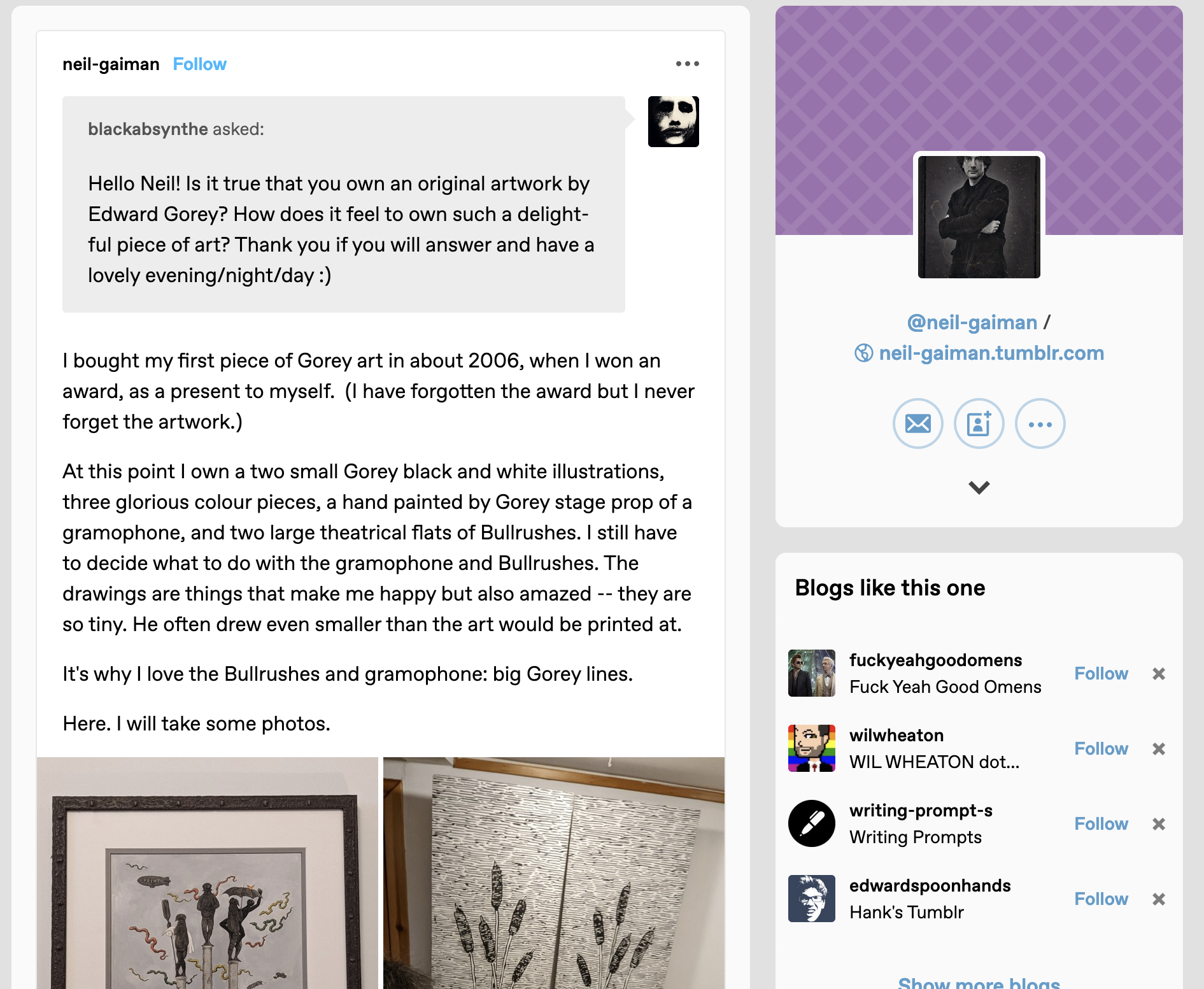
In a post on Tumblr, Neil Gaiman replied to a fan query, asking if he owned any original artwork by Edward Gorey. Mr. Gaiman not only responded in the affirmative, he provided a couple photos of some pieces in his Gorey collection.

The upper left photo shows the magnificent original artwork from Print Magazine. The other three photos show large, hand painted theatrical set pieces. Mr. Gaiman appears in a discrete selfie in upper right photo showing the pair of large set panels.
Mr. Gaiman has been interviewed for the upcoming documentary about Gorey's influences on his work by filmmaker Christopher Seufert. There are four interview clips posted on YouTube including this one: https://www.youtube.com/watch?v=WcJX_TTpBKU


Tuesday, November 8, 2022

The Insomniac's Garden

As discussed in a previous post, Edward Gorey created 34 magazine/periodical cover designs over the course of his career. Mr. Gorey's cover for the June 1984 issue of TWA's Ambassador Magazine is titled The Insomniac's Garden. Several artists contributed artwork for the feature "Gardens You Never Dreamed Of" inside this issue.

The Insomniac's Garden is a study in grey tones, and the overall coloration suggests that the garden might be located in northern Sweden where the sun never completely sets during the month of June (the month this magazine was issued). Since Ambassador is an airline magazine whose goal is to promote international travel, it is a witty commentary on travel by Edward Gorey, a man who only traveled outside the United States once in his life. 

A pale midnight sun hangs in a washed grey sky over a garden surrounded by a high wall along which unkept topiary runs rampant. A sleeping cat lies on top of the wall, undisturbed by the perpetual twilight. A single tall column topped with an urn rises from the center of a garden maze that has either been recently planted or is stunted. 

A solitary woman in a long nightshirt wanders forlornly within the maze, her gaze distracted, her steps faltering. Our fretful insomniac lives in this nightless world where all colors are reduced to one tone. The only non-grey color in the piece is the woman's skin and the pink ears and red eyes of her bunny slippers. These pink tones are mimicked in the line of type at the top of the cover.

At 8.5" x 11" (image size on larger board), this is a large color painting for Edward Gorey. The layout is quite sophisticated and showcases Mr. Gorey's consummate skill as a graphic artist. The piece was carefully composed with space for all of the required elements of the magazine's cover. It is a true test of Mr. Gorey's skill as an illustrator to note that the image is equally satisfying when viewed as a magazine cover or as a painting without the type.

When I acquired this wonderful piece of art, I was surprised to find that: 

A) it was painted on illustration board - a somewhat unusual substrate for Edward Gorey to work on.

B) The front surface of the board with the painting had been professionally removed from the board itself with the utmost precision. This difficult technique is usually employed when a piece is in need of preservation, but this was done when Mr. Gorey sent the art to the magazine and was returned to him in this condition.

To unravel the mystery of why the painting would have been removed from the surface of the board we have to examine image reproduction methods and machinery used in the magazine industry in the 1980's. Like most travel oriented magazines, Ambassador was primarily illustrated with photos and the highest quality technology at the time to scan an image for printing was to use a drum scanner (https://www.pcmag.com/encyclopedia/term/drum-scanner). Photos, transparencies, or artworks needed to be wrapped around the drum of the scanner and Edward Gorey's artwork was painted on illustration board. The only way to wrap the painting was to remove it from the surface of the board by cutting the painting from the backing. The other paintings in the feature were photographed for reproduction and (according to one artist) poorly reproduced inside the magazine. Being the cover of the magazine, the Gorey image would be given special treatment.

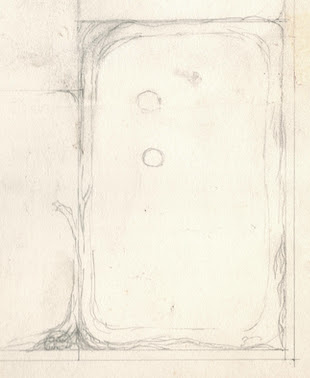
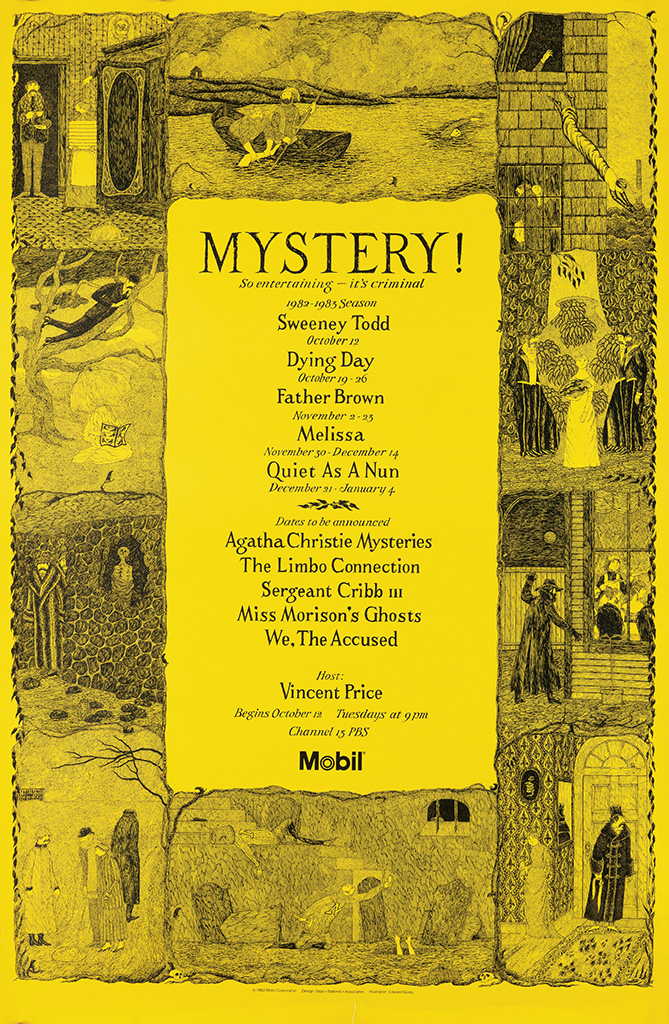
The back of a piece of artwork often tells its own story and the back of this piece is no exception. Like most artists, Edward Gorey occasionally exhibited a frugal streak when it came to reusing papers and boards. For this piece, he chose a board on which he had begun to block out a poster design for Mystery! The board has been cut down for this project, but the divisions for the vignettes are clearly indicated and the beginnings of a decorative border has been sketched in on the lower right.

This poster design would be used for several seasons of Mystery! with the central block of type changing for each season.


Sunday, October 16, 2022

Edward Gorey's Magazine Covers Part 2 - The Full Color Covers


As discussed in the previous post, over the course of his career Edward Gorey created a total of 34 published magazine covers. Only 8 of the 34 covers were conceived as full color paintings, the rest being black and white drawings that sometimes had some color dropped in, or colored backgrounds added.  

In addition to the eight published color covers, there are also four unpublished full color designs.


Edward Gorey's first black & white magazine cover was published in 1950 by the Harvard Advocate, but it was not until the December 1971 issue of National Lampoon that a full color Gorey cover would appear. Unlike many of his previous black and white designs for other publications, this clever and amusing illustration lacks a bold visual appeal. The muted tones and block of small type appears fussy, and the dreary subject, while amusing, is not an endearing holiday image.   

The playful May 1975 Publishers Weekly cover is the boldest full color cover of the 1970's. With this cover, Edward Gorey hearkens back to his work for Anchor Publishing, and creates an illustration that incorporates all aspects of the magazine cover into a singular image. The masthead, logo, and typeface are reflected both in color and style on the wings of the flying figure, and the overall layout is conceived as a single Gorey-designed piece. The use of small speech bubbles would be more appropriate for an interior illustration than a cover image, but the design has a strong graphic sensibility. 

The June 1975 issue of National Lampoon has a better conceived cover image than the December 1971 Lampoon cover, but it still does not take full advantage of its prominent position. While Edward Gorey rarely used speech bubbles in his own work, he cannot seem to leave them off his color cover designs. Interestingly, the use of speech bubbles does not appear on any of his black and white magazine cover designs (see previous post for images).

1983's cover illustration for Radio Shack's Hot Coco magazine looks even more like a panel cartoon than the National Lampoon covers. This is mainly due to the artwork's placement on the cover, and the large speech bubble. With an Edwardian family discussing the merits of a color computer (CoCo stands for Color Computer), the image is colorful and humorous, but the layout of cover as a whole is pedestrian and unimaginative. The image itself is expertly rendered with painted details intermingling with line work to create different textures and surfaces. The use of color in this piece is subtle and quite beautiful.

Edward Gorey finally comes into his own with the June 1984 TWA Ambassador Magazine color cover. Titled The Insomniac's Garden, this piece is one of several "fantasy garden" images created by different artists that are featured within this issue. The drawing has been designed by Mr. Gorey as a complete concept, with room for the masthead and typography accommodated within the illustration. The design is bold, eye catching, and completely visual. Gone are the cartoon caption bubbles, leaving the viewer free to muse on the image. The piece is a subtle study in grey tones, with the occasional pinpoint of color to draw the eye.

Gracing the cover of the February 1988 issue of Print Magazine is another breakthrough design that fully celebrates Edward Gorey's talents as a magazine cover illustrator. The colorful painting explodes with imagination and Mr. Gorey's enigmatic visual humor. The image is accessible, yet delightfully puzzling.

In 1992 Edward Gorey submitted two full color pieces to The New Yorker for consideration, one of which was published as the cover of the December 1992 holiday issue. Papering the Tree would be the last color magazine cover by Mr. Gorey published during his lifetime. Once again, the artist has created a colorful, stimulating image that is full of humor. Instead of wrapping presents to put under the tree, this extended family is wrapping the tree itself - and the cat & dog.

Submitted to The New Yorker magazine in 1992 along with Wrapping The Tree, Cat Fancy was set aside by the editors to be virtually forgotten. Rediscovered many years after Edward Gorey's death, this masterpiece work would finally appear on the cover of the December 2018 holiday issue. Layers upon layers of fabric, pillows, dust ruffles, and duvets adorn an overstuffed bed whose inhabitants are a pair of reclining cats. 

Unpublished Cover Designs

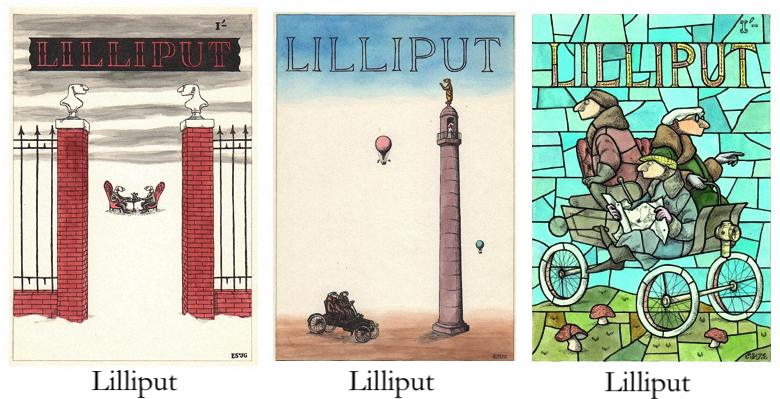
Gorey's earliest full color magazine covers were created for Lilliput Magazine, a British publication that combined humor with daring photos of unclad women. These paintings were created in the late 1940's/early 50's, and it is not known if these designs were actually submitted to the magazine for consideration. Each of these eye catching illustrations has well balanced images and a sophisticated use of color. The Lilliput designs were never published, and these three pieces of original art are in my personal collection.

Finally, along with the three Lilliput images from the 1950's, a fourth unused full color cover design was created by Edward Gorey in 1993. Flappers and Topiary is an imaginative image that, like Cat Fancy, was set aside by the staff at The New Yorker when it was submitted to the magazine in 1993. This image has yet to appear on the magazine's cover, but it was published as a full page memorial in the magazine shortly after Mr. Gorey's death.

Cover images provided by Irwin Terry, Sam Spiegel, Swann Auction Galleries, Internet Search


Friday, October 7, 2022

Magazine Covers


As a freelance illustrator, Edward Gorey created images for a wide variety of publications including books, newspapers, catalogs, and magazines. As early as 1950 Edward Gorey's artwork graced magazine covers, but they would not appear with any frequency over the course of his career. The sporadic nature of his cover appearances is likely because Mr. Gorey was primarily a book illustrator and that is where his energies were focused. While he produced hundreds of images for periodicals, Mr. Gorey created 34 images specifically for use as magazine covers. In addition, there were 5 images that were intended but never published as magazine covers. The relatively small number of Gorey designed magazine covers can be compared to Charles Addams, who created 64 covers for The New Yorker magazine during his career.  


These pictured groupings bring together all the known Gorey designed magazine covers (missing covers will be filled in as images turn up). Over the years, other images by Edward Gorey were hijacked and put onto the covers of magazines, but those images were not intended as cover designs so they have not been included here. 

Cover images provided by Irwin Terry, Sam Spiegel, Swann Auction Galleries, Russell Lehrer, Todd Camp, Internet Searches.